


Editor’s Review
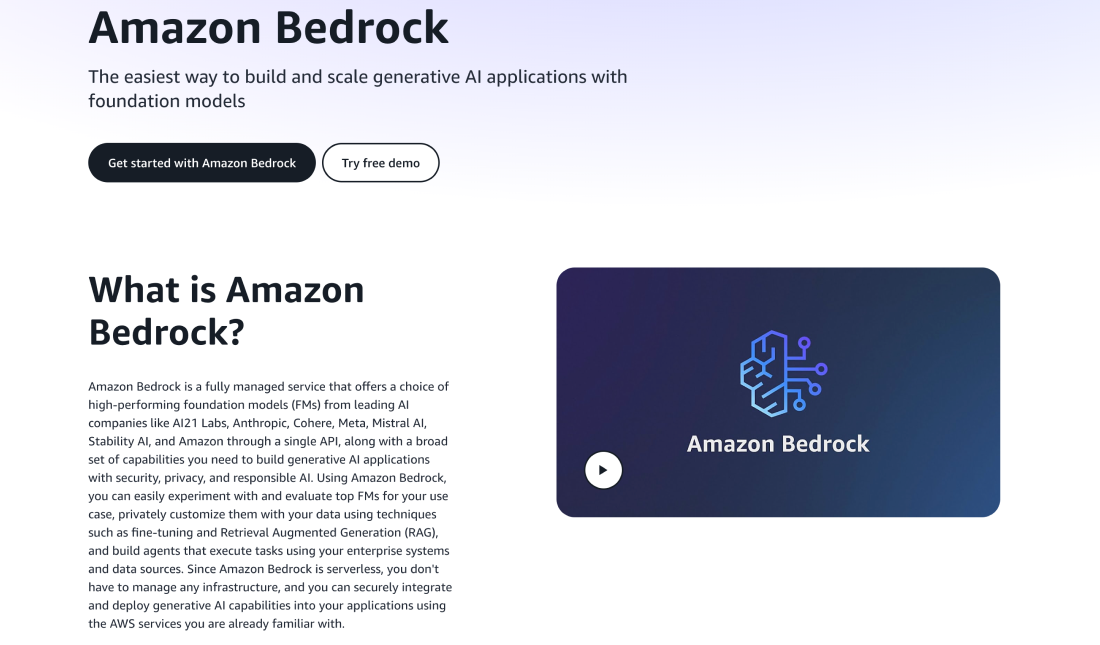
Amazon Bedrock is an innovative AI tool that is revolutionizing the way businesses approach data management and analytics. Developed by Amazon Web Services (AWS), Bedrock offers a comprehensive and scalable solution for enterprises looking to streamline their data pipelines and gain deeper insights into their operations. With its advanced capabilities, Bedrock is helping organizations of all sizes unlock the full potential of their data and make more informed decisions.
One of the key advantages of Amazon Bedrock is its ability to seamlessly integrate with a wide range of data sources and destinations. Whether you're working with relational databases, NoSQL databases, or cloud-based storage solutions, Bedrock can easily connect to your existing infrastructure and streamline the flow of data between different systems. This makes it an ideal solution for organizations that need to integrate data from multiple sources and consolidate it into a single, cohesive view.
Another important feature of Amazon Bedrock is its visual workflow builder, which allows users to create and manage data pipelines with minimal coding required. This intuitive interface enables data engineers and analysts to drag and drop components into a visual canvas, defining the flow of data and specifying the necessary transformations and filters. This not only simplifies the process of building data pipelines but also makes it easier for non-technical users to understand and collaborate on data integration projects.
In addition to its data integration capabilities, Amazon Bedrock also offers advanced monitoring and alerting features that help users keep track of their data pipelines in real-time. With Bedrock, you can easily monitor the performance of your data pipelines, track the progress of data flows, and receive notifications when issues arise. This enables you to quickly identify and resolve problems, ensuring that your data pipelines are always running smoothly and efficiently.
In conclusion, Amazon Bedrock is a powerful AI tool that is transforming the way businesses approach data management and analytics. With its advanced capabilities, including seamless data integration, visual workflow builder, advanced monitoring and alerting features, and seamless scalability, Bedrock is helping organizations of all sizes unlock the full potential of their data and make more informed decisions.
Features
1. Unified API Access: Amazon Bedrock provides a single API interface for accessing multiple FMs, allowing users to easily switch between models or upgrade to newer versions with minimal code changes. This flexibility ensures that users can stay up-to-date with the latest AI innovations.
2. Customization and Personalization: Bedrock enables users to tailor FMs to their specific needs through techniques like fine-tuning and retrieval-augmented generation (RAG). By uploading their own data, users can enhance the performance of the models and make them more relevant to their use cases.
3. Secure and Reliable Platform: Built on Amazon's cloud infrastructure, Bedrock offers a highly secure and reliable platform for running AI applications. It adheres to strict security protocols and ensures that user data remains protected at all times.
4. Extensive Functionality: Amazon Bedrock supports a wide range of AI applications, including natural language processing, image recognition, and more. It provides tools for creating chatbots, assistants, and other AI-powered solutions that can automate tasks and improve user experiences.
5. Cost-Effective: While the cost of individual image generation might seem high, Amazon Bedrock offers cost advantages over building and maintaining your own hardware infrastructure, especially for enterprises requiring large-scale services. The pay-as-you-go model ensures that users only pay for the services they use.
Pros
1. Ease of Use: With its unified API and intuitive user interface, Amazon Bedrock makes it easy for users to experiment with different FMs and build AI applications without extensive technical expertise.
2. Flexibility: The ability to switch between models and upgrade to newer versions with minimal effort gives users the flexibility to stay on top of the latest AI trends.
3. Customizability: The fine-tuning and RAG capabilities allow users to tailor FMs to their specific needs, ensuring that the AI applications are highly relevant and effective.
4. Security and Reliability: The cloud-based platform offers robust security measures and high availability, ensuring that user data remains safe and applications run smoothly.
Cons
Currently, Amazon Bedrock primarily supports English, which can be a limitation for users who require support for other languages.