


Editor Reviews
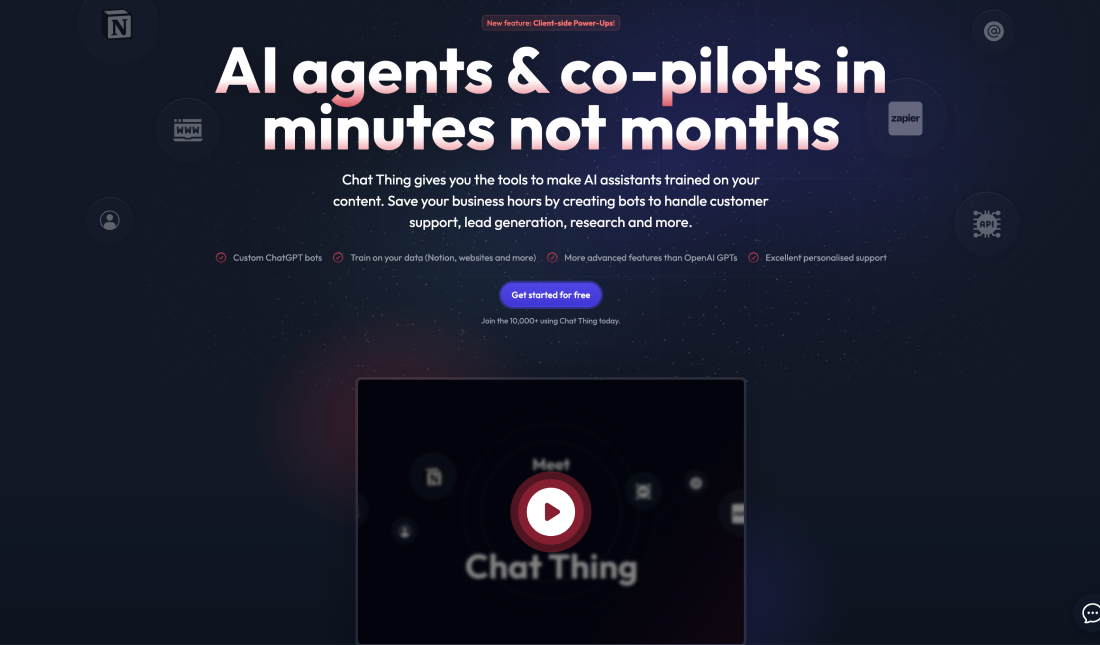
In an era where digital transformation is accelerating, Chat Thing emerges as a comprehensive and powerful AI bot builder, capturing attention across industries seeking advanced interaction capabilities. Harnessing the vast potential of artificial intelligence, Chat Thing stands out as an innovative tool specifically designed to seamlessly integrate conversational AI into various platforms and applications. With its expansive suite of features, Chat Thing is equipped to address the evolving demands of automated interaction, making it an ideal solution for businesses, educators, and developers striving to enhance customer engagement and streamline operations.
The origins of Chat Thing trace back to the trending need for dynamic interaction models that can efficiently process, interpret, and respond to user queries in real-time. Unlike traditional static interfaces, conversational AI allows for a more nuanced understanding of user intent, resulting in more accurate and relevant interactions. This shift towards conversational models is further amplified by the tool’s adaptability to multiple platforms, reflecting its design ethos centered on flexibility and user-centricity.
As digital environments become more interconnected, the need for tools that can easily integrate into existing ecosystems becomes imperative. Chat Thing’s ability to link with popular platforms such as Discord, Slack, WhatsApp, and Telegram exemplifies its commitment to providing versatile deployment options. This flexibility ensures that organizations can capitalize on their existing digital frameworks while augmenting them with AI-driven insights and interactions, ultimately enhancing the user experience.
Moreover, the capability of Chat Thing to manage a wide range of data sources stands as a testament to its versatility. The tool’s ability to assimilate and process diverse data types—from PDFs and CSV files to Notion databases and YouTube content—demonstrates its potential in generating rich, multifaceted interactions. By leveraging these data sources, Chat Thing not only delivers substantial value in terms of content generation and information dissemination but also empowers users to derive actionable insights from complex datasets.
In conclusion, Chat Thing offers a robust suite of features designed to enhance conversational AI through versatile integrations and broad data-handling capabilities. Its strengths lie in adaptability, efficiency, customization, and integration, making it a valuable asset for various sectors. However, potential users should consider the complexity, cost implications, reliance on user feedback, and variability in responses as factors that could influence their experience with the tool.
Features
1. Chat Thing supports integration with popular platforms such as Discord, Slack, WhatsApp, and Telegram, allowing for broad application and user reach.
2. It efficiently handles various data formats, including PDFs, CSVs, Markdown files, and even entire websites, making it highly adaptable.
3. Features like auto-syncing ensure that data remain up-to-date by automatically refreshing with new or modified content, which is crucial for maintaining relevance.
4. Users can personalize their bots with customizable prompts and themes, tailoring the interaction tone and appearance to fit specific needs.
5. Chat Thing incorporates a feedback system to refine its responses based on user input, ensuring continuous learning and improvement.
Advantage
1. Chat Thing’s ability to integrate with a multitude of platforms and handle diverse data formats underscores its flexibility and scalability for different use cases.
2. The auto-syncing feature optimizes content management by updating only new or modified information, saving time and resources.
3. High levels of bot customization in terms of appearance and dialogue offer tailored user experiences, enhancing engagement and satisfaction.
4. The inclusion of feedback mechanisms ensures that the system continuously evolves, improving its performance and user relevance over time.
Shortcoming
1. For non-technical users, initial setup and integrations can be daunting due to the multitude of customization and data configuration options.
2. While offering many features, some advanced functionalities may require subscriptions, impacting cost-effectiveness for small businesses.
3. The tool’s reliance on user-provided feedback to improve can lead to inconsistent performance if engagement is low.
4. While customizable, the variability in response can sometimes lead to unpredictability, which might not suit all business contexts.